
What you will get
Card accepted on your plan, with the difference that confuses nearly everyone settled first: the card does not produce a payment book.
The difference that changes everything
With bank slips and PIX, twelve instalments become twelve charges, one a month. On the card, twelve instalments become one charge, for the whole amount.
The splitting happens on the student's card bill, not at the school. The school receives it all at once; the student pays their own bank over twelve months.
That is why, on an enrolment paid by card, the instalment panel shows a single row, with the full amount. It is not a bug.
That row falls due three days after the enrolment (or after the billing start, when that is later). It is the student's deadline to pay: the link goes out on its own when the enrolment is created and, if the deadline passes without payment, the instalment becomes overdue just like bank slip and PIX ones.
The card fields
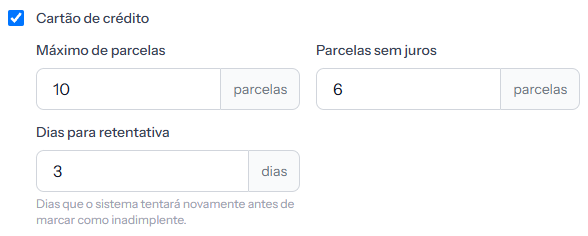 The first two describe your offer on the screens. The third is the one this article asks you to leave alone for now.
Max instalments and Interest-free installments build the sentence the buyer reads — "up to 10x, 6x interest-free" — on the plans list, on the enrolment screen and on the sales page.
Worth knowing what they do not do: they do not configure the card machine. How many instalments the student can actually pick at checkout, and who pays the interest, are set on your payment account — not here.
Treat the two as the commercial description of your offer, and keep them aligned with what your payment account really offers.
The Retry days field
Leave it blank. The hint underneath promises the system will try the charge again before marking the student as defaulted, and that retry does not happen today — the value stored there is read by no routine.
Until that changes: a declined card is not retried on its own. If the student does not try again by the due date, the instalment becomes overdue and starts showing up in the overdue notices, like the others.
When the card pays off
- A quick sale, where the family decides on the spot.
- A lower-value course, where a payment book is not worth the work.
- Immediate cash, when the school's cash flow is tight.
For long monthly commitments, bank slips and PIX stay more predictable — and cheaper, because card instalment fees add up.
How you know it worked
On the plans list, the Credit card column starts showing até 10x and, underneath, 6x sem juros. On the enrolment, the card appears among the payment methods.
If something goes wrong
A card enrolment produced a single instalment. That is the correct behaviour. The splitting happens on the student's bill.
The card instalment has a due date. It is the student's three-day deadline to pay, not the date of their card bill. Only older card enrolments, created before this rule, still have no due date.
Card does not appear among the enrolment's payment methods. The system only offers the methods the school's payment account can actually charge. If card is turned off there, it drops out of the list, even when the plan accepts it.
The student managed to split it into more parts than you configured. The Max instalments field describes the offer, but does not limit what the payment account offers at checkout.
A payment was declined and nobody was told. That is a known limitation: the refusal is recorded on the instalment and triggers no notice right away. If the student does not pay by the due date, the instalment becomes overdue and goes into the daily overdue report the school owner receives.
Reviewed on · view as plain text