
What you will get
A plan that produces the payment book the way your school charges. Ticking Bank slip under the accepted payment methods reveals four fields — and two of them do all the work.
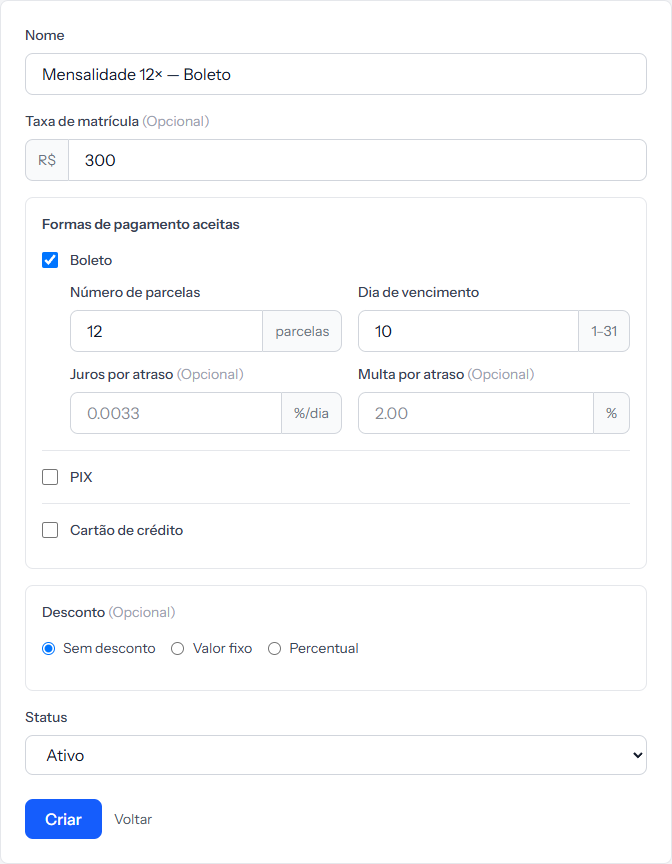 The top two fields build the payment book. The bottom two, late interest and late fee, are out of this article — the reason is at the end.
Number of instalments
How many parts the course value is split into. It takes 1 to 255.
The maths is simple: course value ÷ number of instalments, rounded to cents. A R$ 1,200.00 course in 12 parts gives twelve instalments of R$ 100.00.
When the division is not exact, the difference goes on the last instalment. R$ 1,000.00 in 3 parts gives R$ 333.33, R$ 333.33 and R$ 333.34. In 7 parts, six instalments of R$ 142.85 and a last one of R$ 142.90.
The total always matches the contract value; only the last instalment ends up a few cents different from the others.
Due day
The day of the month the instalments fall due, 1 to 31. The same for all of them.
Short months: with day 31, February falls due on the 28th (or 29th). The system uses the last day of the month when the chosen day does not exist, and returns to the 31st the following month.
Where the first due date comes from
This is the part that surprises people. The system looks for the first date on or after a reference date whose day matches the due day.
And the reference date is chosen in this order:
- The billing start date, if you filled that field in on the enrolment.
- The cohort's start date, if it falls after the enrolment date.
- The enrolment date, if neither of the above applies.
In practice: enrol someone on 5 August under a plan with due day 10, and the first instalment falls due on 10 August. If the cohort only starts in February, the first one falls due on 10 February — which is what most schools want, without doing anything.
How you know it worked
Make a test enrolment and look at the instalment panel: the count matches what you configured, all with the same amount (the last one may differ by a few cents), falling due on the same day of consecutive months. Then cancel the test enrolment.
With the receiving account connected, the test enrolment already issues on the spot the charges falling due within the lead time, with an email to the student. Use a test student with an email address of your own.
The two late fields
Late interest rate and Late fee are deliberately out of this article. The calculation they feed does not match what the screen's labels promise, and the matter is under review.
Meanwhile: leave both blank and, when issuing a second copy, check the proposed amount against your contract's rule before saving.
If something goes wrong
The first instalment fell due earlier than you expected. Check the cohort's start date and the billing start field on the enrolment — one of the two drove the calculation.
The last instalment has a different amount from the others. That is the cents adjustment explained above: the remainder of the division goes on it, so the total matches the course value.
You need different due days for the same course. Create one plan per due day. It is the most common reason to have several plans.
The student wants fewer instalments. That is a different plan, picked on the enrolment. A plan does not offer "1 to 12" — it has one fixed number.
Reviewed on · view as plain text