
What you will get done
Knowing where a debt sent to a notary stands, without calling anybody or logging into another system.
After the send, the registry service is the one bringing news. EduPay receives each change and updates the screen on its own — you do not have to check anything.
Where to look
In Contracts › Delinquency 90+, click the coloured button in the Status column. It opens the title page.
The colour alone tells you a lot from a distance:
| Colour | What it means |
|---|---|
| 🔵 Blue | Under way at the notary. Nothing to do |
| 🔴 Red | Protested. The student's name is blacklisted |
| 🟠 Orange | Returned. Needs your attention |
| 🟢 Green | Paid |
| ⚪ Grey | Closed |
Red is the only one that actually changes the student's life. That is why it has a colour of its own rather than sharing the one used by the in-progress states.
The statuses, one by one
AGUARDANDO_COLETA — the title reached the service and is queued to go to the notary. This is the only moment when the send can be cancelled at no cost.
COLETADO — it left for the notary. From here on, undoing costs money.
NO_CARTORIO — filed. The notary will summon the student. The screen now shows which notary and the filing number.
PROTESTADO — the protest was recorded and the student's name is blacklisted. This is the state with the heaviest consequence, and the point where most students get in touch with the school.
PROTESTO_POR_EDITAL — the same thing, when the notary could not locate the student to summon them and published a public notice instead.
PAGO — the student paid at the notary. The instalment is settled automatically in EduPay.
DEVOLVIDO — the notary refused the title and gave a reason. A return is not a protest: the student's name was not blacklisted and there was no cost.
PROTESTO_CANCELADO and RETIRADO — the matter is closed.
SUSTADO and SUSPENSO — progress stopped by a court decision or by the notary itself. In those cases it is worth talking to legal before doing anything.
When the student pays at the notary
The money reaches the school's account directly through the notary — it does not go through EduPay's usual collection route. That is why the settlement is recorded as a manual payment, with a note saying it came from the notary and the title number.
Do not try to match that payment to the old invoice: they are different things, and the instalment already shows as paid.
The amount received can be higher than the instalment, because the notary fees come with it. That is normal.
The timeline
At the bottom of the page, the Progress block lists everything that has happened, newest first: every status change, with date and time, and the actions somebody at the school took.
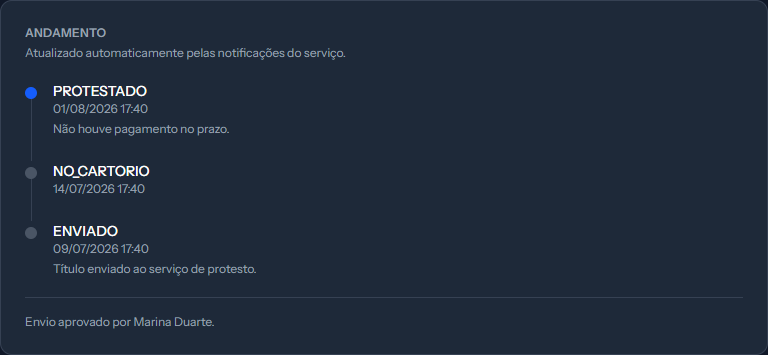
The blue dot marks the current status. Below it comes the whole route, and the footer records who approved the send.
This history is read-only. Nobody edits or deletes it — not the team, not the account administrator. It is what answers "what exactly was done, and when" if the collection is ever challenged.
The debtor snapshot
The Debtor — as sent block shows the data exactly as it went to the notary: name, document, city and address.
It does not follow the record. If somebody corrects the student's file later, this screen keeps showing what the notary received — which is precisely what matters when explaining a return or defending a filing.
How to know it is all working
The status changes on its own, without anybody pressing anything, and each change shows up on the timeline with date and time.
If a title sits in an intermediate status for several days, that may simply be the notary's pace — they work business days. If the doubt persists, support can check from the service side.
If something goes wrong
The status has not changed in days. First check whether the registry authorisation expired: without it EduPay stops receiving the news, even though the title keeps running at the notary normally.
The student says they paid and the instalment is still open. Ask where they paid. If it was at the notary, the settlement arrives with the payment notice. If it was through an old invoice, the route is different — and the protest needs to be cancelled.
The screen shows a notary in another city. That is expected: the notary is decided by the municipality where the student lives, not where the school is.
Reviewed on · view as plain text