
What you will get
A way off the blank page. Finding the school here that most resembles yours and copying its structure is usually faster than deciding from scratch.
The rule that holds for all four: start small. Too much structure on day one gets in the way; you can always add later.
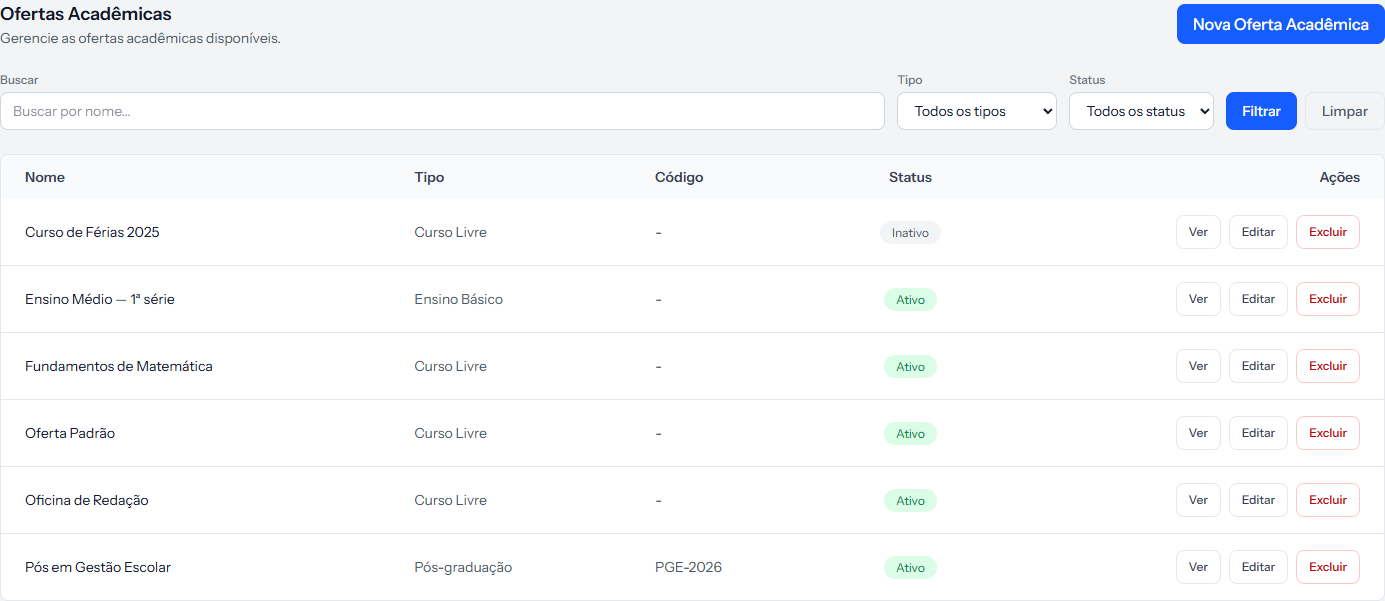 This is the list you are building. It can mix types freely — one school can have a postgrad programme and a workshop side by side.
1 · A school selling standalone courses
Free courses, workshops, exam prep. Each person buys one course.
| Piece | How it looks |
|---|---|
| Offerings | One per course |
| Cohorts | One per course and period — Writing — 2025.2 |
| Trails | None |
The simplest case, and the most common. It is worth opening a new cohort each period instead of reusing the old one: the name with the period is what keeps the history readable two years from now.
2 · A regular school
Early years, primary, secondary. The student enrols in a school year.
| Piece | How it looks |
|---|---|
| Offerings | One per year group — Secondary — Year 1 |
| Cohorts | One per year group and shift — Year 1 A — Morning |
| Trails | None |
The offering is the year group; the cohort is the classroom. Here the cohort does the heavy lifting, because it is what separates morning from afternoon.
It is worth using the K-12 type on the offerings: it changes no rule, but it makes the list filter useful once the school grows.
3 · Postgraduate programmes
Cohorts with defined intakes, long contracts, many instalments.
| Piece | How it looks |
|---|---|
| Offerings | One per programme — Management Postgrad |
| Cohorts | One per intake — Management Postgrad — 2026.1 |
| Trails | None, unless you sell the programme in blocks |
Here the cohort's start and end dates are worth gold: they go into the contract, and they are the detail students ask about most afterwards.
4 · A programme sold as a package
Several modules bought at once, at a closed price.
| Piece | How it looks |
|---|---|
| Offerings | One per module, each with its own base price |
| Trail | One, gathering the modules in order |
| Cohorts | One per intake of the whole programme |
The only case where a trail truly pays off. The summary panel adds up workload, duration and value, and serves to check whether the package price adds up.
Three questions that settle the doubt
"Is this a product or a group of people?" A product is an offering. A group of people is a cohort.
"Does the student buy it separately?" If yes, it is a standalone offering. If it is only ever bought together, it is a trail.
"Will I need to separate by period?" If yes, the period goes in the cohort's name — never in the offering's. An offering with a year in its name ages and turns into a list of duplicates.
How you know it worked
The real test is a trial enrolment: if you can pick the product and the cohort without hesitating, and the name appearing on the contract makes sense to the family, the structure is good.
If something goes wrong
The offerings list became a pile of repetitions with years in the names. A sign that the period went into the offering instead of the cohort. Rename the offerings without the year and create cohorts per period.
You are torn between two structures. Pick the simpler one. Changing later is work, but too much structure from the start is work every single day.
The school sells in two different ways. You can mix: nothing stops standalone offerings and trails living in the same catalogue.
Reviewed on · view as plain text