
What you will get
Knowing what is inside the default template before adopting it, and what your school will probably need to add.
This is not legal advice. The default template is a technical starting point. Whoever validates your school's contract wording is your school's lawyer.
The clauses the default template carries
| Clause | What it covers |
|---|---|
| 1 — The parties | Identification of the school and the student, with ID, address and contact |
| 2 — The subject | Which course, which cohort, start date |
| 3 — Amount and payment terms | Total, instalments, due day, enrolment fee and the late-payment rule |
| 4 — The institution's obligations | What the school commits to deliver |
The text is in Portuguese and written for a Brazilian school. If your school operates elsewhere, it serves as structure, not as content.
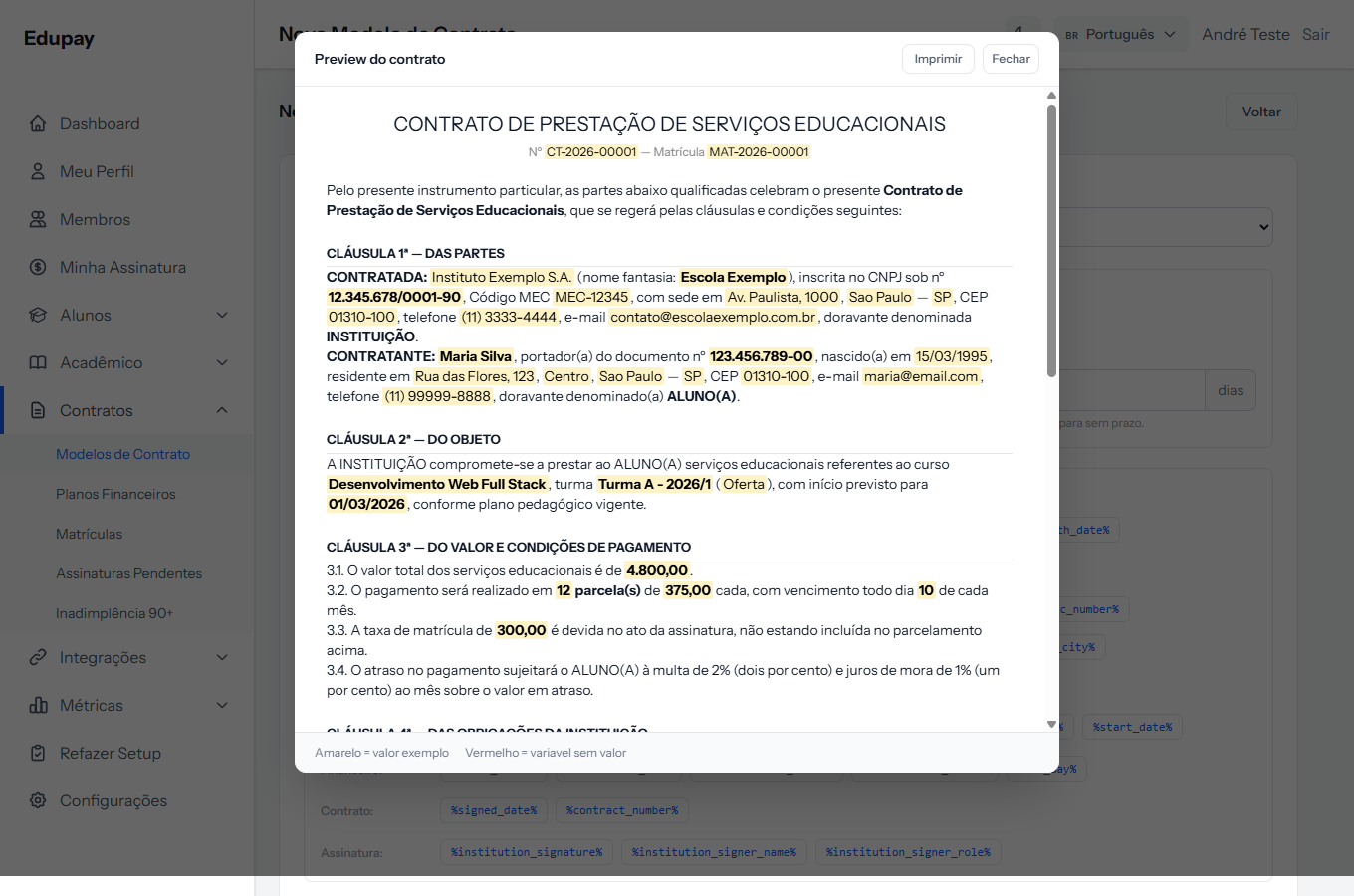 The quickest way to read the whole default template is to open it in Preview and click Imprimir — print — which gives you a PDF to review calmly, or to hand to your lawyer.
Three things to review before using it
1. The late-payment rule is spelled out in words. Clause 3.4 of the default template carries a 2% penalty and 1% monthly interest, written into the text — they come from no field in the system.
That is good: the contract does not change by itself. But it means you have to check whether those numbers are your school's and rewrite them if they are not.
2. The payment clause needs one fix. The default template repeats the word "dia" before the due-day variable. The formatting-mistakes article, next door, shows exactly what to delete.
3. The course type comes out as an internal code. In clause 2,
%course_type% prints free_course instead of Free Course. Drop the variable
or write the type by hand.
What usually goes missing
The list below is what most often appears in school contracts and is not in the default template. Take it to whoever handles the legal side:
- Cancellation and termination — notice period, what happens to instalments already due and still to come, whether there is a penalty and how much.
- Withdrawal before classes start — usually a different rule from mid-course termination.
- Price adjustment — if the amount changes on a contract that crosses the year.
- Use of image — photos and video in activities and marketing.
- Data protection — which data the school keeps, for how long and why.
- Jurisdiction — where any dispute is heard.
- Student and guardian obligations — attendance, conduct, materials.
Contracts for minors
If your school teaches minors, the contract is signed by the guardian. The system stores one student record, with one ID and one email.
In practice, schools handle this two ways: they register the guardian as the student for contract purposes, or they add a line to the text for the guardian to identify themselves. Neither is perfect — agree the route with your legal adviser before enrolling the first one.
How you know it worked
Someone who did not write the contract has read the whole text, end to end, and did not stumble on a single sentence. That is the only check that catches the paragraph left over from the default template that makes no sense for your school.
If something goes wrong
The default template looks nothing like your school's contract. Use only the structure and paste your own text over it. The variables work in any text.
You are not sure whether you can use the default template as is. Do not use it without review. It is a technical starting point, and the contract is a document your school signs.
The school has courses with very different rules. Then those are different templates, one per course type. Nothing stops you having several.
Reviewed on · view as plain text