
What you will get
A fixed start-of-week routine. EduPay does the heavy lifting on its own — it issues the charges, notifies the students, settles the payments. What it does not do is tell you everything: some failures only surface for whoever looks.
Twenty minutes every Monday takes care of that.
The four steps
1. Pending signatures
Under Contracts › Pending Signatures. A contract nobody signed is a stuck enrollment, and a stuck enrollment does not charge. Every row sitting there for more than a week deserves a phone call.
2. The week's arrears
Under Metrics › Financial Report, filtering by status and period. Look for the installments that came due last week. They are already marked Overdue — the system does that the night after the due date, with no grace period.
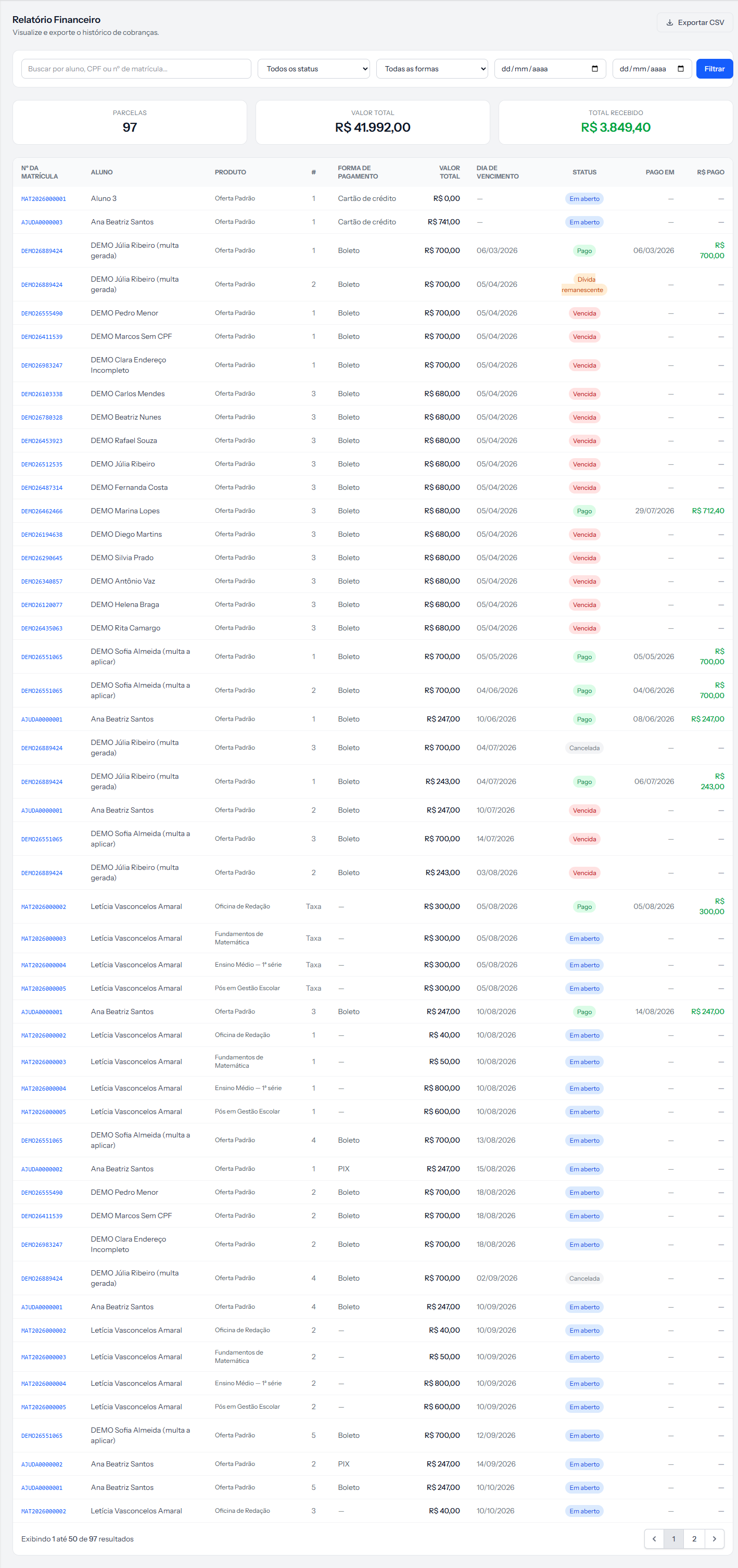 The filters sit at the top. The three boxes below them summarise what was filtered: how many installments, how much they are worth, and how much has come in.
At this point, split them into two groups: those late for the first time, and those who were already late before. The first group is usually forgetfulness and a message solves it; the second is a conversation.
3. Charges that never went out
This step does not go through the report — it does not show which installments were left without a charge. The signal is a different one: the email the system sends to whoever administers the account when the automatic issuing fails. If one arrived during the week, it already names the installment and the reason.
If no email arrived and a student still says they never got a slip, open their enrollment and look at the CHARGE column: a dash on an installment that should already have been charged is the sign. The Charge cancelled on dd/mm/yyyy badge deserves attention too: the routine does not reissue that installment, so it is only billed again if someone issues it from the menu.
The routine retries on its own an installment left without a charge for up to 7 days after the due date. After that it is up to you: issue it from the three-dot menu or create a 2nd Copy with a new due date.
That is the silent gap: if the charge never went out, the student never knew they had to pay, and chasing them later is awkward for both sides. The cause is almost always a disconnected payment account or something missing on the student's record.
4. The month's numbers
Under Metrics › Financial KPIs. Here you do not act, you look: if expected and received keep drifting apart month after month, the problem is not one installment — it is the collection policy, and it deserves a bigger conversation than a Monday one.
When the school uses formal debt collection, the Delinquency 90+ screen joins this round, for the older debts.
How to tell it worked
By the end of the round you can answer three questions without opening anything else: how many contracts are stuck waiting for a signature, who fell behind this week, and whether any charge failed to go out. If you can, the week starts without surprises.
If something goes wrong
The arrears list is huge and you do not know where to start. Start with the larger amounts and the most recent delays — someone a few days late is far more likely to pay than someone months behind.
You find a whole block of installments with no charge. Do not start issuing them one by one. That is a sign the school's payment account disconnected; fix the connection first, and the next morning the automatic routine catches up on its own with the ones falling due within the lead time and the ones overdue by up to 7 days. Only those overdue for longer need to be issued by hand.
The routine takes more than twenty minutes every week. You are probably fixing case by case what is really a policy problem. It is worth revisiting the issuing lead time and the automatic reminders before carrying on fighting fires.
Reviewed on · view as plain text